Monday, September 15, 2014

The North Sea

12 September 2014

Tides are very important here, at low tide the oats side in the mud on their sides and the road to the golf course is accessible, at high tides the boats are afloat and the road is covered by water. With high ride at 9:00, multiple lady neighbors came over to kayak, 8 total, Barney and I in one, Briony and her 81 year old mother in the other double, kayaking through the flooded area at high tide onto the sailors beach. We all had a bacon sandwich and coffee, and then went for a swim in the North Sea, which was very very cold. Briony and Barney were brave swimmers, I lasted about 5.7 seconds.


Back for a quick swim in the warm 87 degree pool, then showers, then we read a bit while Briony had some work for Ambit, then a lovely lunch in the garden.


After lunch, off with Briony to shop, to Walsingham to her favorite farm store, everything's so fresh  and local, got some oatcakes there. They had an astonishing array of pies and every imaginable sweet and savory in a crust.


Then off to Fakenham, where Briony had some business or attend to, and our job was to find a key cutter to make  copy of one or her keys, see found a Cobbler and were successful in getting the key done.

We walked around the town, had some tea, them drove back to Staithe House.  Sally and Ian arrived from London, Sally and Briony knew each other on Southern California and have daughters the same age.  Went out to pick more raspberries for jam, also basil, tomatoes, and runners beans, while Barney dug potatoes. Dinner was local crab salad in the shells, with runner beans and leeks, potatoes, dessert was Briony's shortbread with raspberry jam. Our bed was warm and fluffy the beside from our window spectacular.

On to Brancaster Staithe

11 September 2014

We get up early and take the tube to St.Paul’s Cathedral, burial  place of most of England’s most illustrious sons and a few daughters. An imposing edifice, the nave is fairly plain (the area where the people sit) while the choir and alter are enormously elaborate and decorated. One of the many churches designed by Christopher Wren after the Great Fire of 1668, it epitomized the institutinoalizationofnthe Anglican Church. In the crypt, Nelson’s tomb is quite amazing … I can’t think of any American military hero who is quite as revered as Lord Nelson was. From the top of the dome, we saw the skyline of London, both the old and the new (notice the enormous numbers of cranes).


Rushing back to The Orange, all packed and ready to go, we wait for our ride to King’s Cross station. And wait.


We were to meet Maureen Matthews, Briony’s mother, on the train to Kings’s Lynn. Because of cross-town traffic, we missed our rendezvous moment with Briony’s mother, so called her frantically to arrange to take the next train and then the bus to Staithe House. We run into the station, a very helpful man helps us get our tickets (and we find out we have something called an old pound (which is no longer legal tender), and we run for the front four cars of the train, making it just in time. Throwing our bags inside, Barney went to look for Maureen, and he found her right away. A quick call to Briony and all was well. The  train headed out one minute later, and off we went to Norfolk!

Norfolk was pretty … fairly flat and very green, and you can see landmarks like Ely Cathedral looming in the distance from far away. We’re picked up at the train station by Eddie, Briony’s garden and caretaker, who we later learn has been taking care of the garden for some 50, yes 50, years. He’s also done some butlering at Sandringham (where the Queen and her family spend Christmas), so he gave us some of the inside gossip, especially about the house William and Kate are preparing nearby. He said that the Queen really likes coming to Norfolk because she can be herself, walk around town and not be harassed.

Briony and Simon’s home is called Staithe House, and was the famous architect and designer William Kent’s own house. Every room has different moldings, with authentic paint colors and furnishings in the old Georgian part of the house, and a more modern (yet very comfortable) hook in the large new addition on the back. The views from the back were breathtaking, of the creek then the golf course then the North Sea.


We settle in, then take a walk up the street to the Jolly Sailors pub, for half-pints of ale, sandwiches and pizza. Briony arrived with the dogs, Gatsby full of energy, Cassie wanting to be left alone. Briony clued us in that men don’t order half-pints of ale, for future reference. Briony suggested that we take advantage of the early high tide to go kayaking in the morning. Off we went to our lovely room with a view of the sea.

Thursday, September 11, 2014

Exploring London

10 September 2014

Having gotten back late the night before, we awoke late, and went across the street to Daylesford’s an upmarket combination of the Pasta Shop and Oliveto, with everything organic, free-range and made by hand. We had delicious yogurts and fruit plus toast and coffee, all the while watching the parade of contractors pull up at the Travis Perkins building supply place, where the crews doing renovations in local homes came to get supplies, rather like Home Depot. This neighborhood is filled with designer shops of all types, antiques to modern, even one from the 18th century. By the time we were eating, well after 9:00am, the place was all slender, mostly blonde women between 25-45, very well dressed, most wearing huge gold watches, and I’ve never seen so many Birken bags in one place in my life.


We went back to get ready to go out, and saw that the door to St. Barnabas was open across the way.  We went inside, and found this lovely and unique church, built in Early English style in the mid-19th century, one of the only churches in London which is home to both Anglican and Catholic services. The caretaker was there and invited us in, said we could take photos. It’s a lovely little place, beautifully decorated with statues and artwork and wood choir and altar. Earlier in the morning we had seen the children arriving for the first say of school, and what was so interesting was that at least 10-15 of the mothers were wearing hijab, seeing their children off to a Church of England school. The ethnic diversity of the school – probably only 20% Caucasian - reminded me of the Oakland Catholic schools.


Off we go on the #11 to Westminster station, where we finally got a map, and walked around the Parliament building. We transferred to the train to Waterloo and walked to Southbank Centre, an arts center, very lively, for lunch with my colleague Greg Klerkx, formerly of the SETI institute.


I had not seen Greg for 8 years, when he was on tour for his first book. His little girl is now 11 years old, a talented musician, and both he and his wife, also a writer, are doing well. Besides his new novel, he leads educational coaching programs and also produces new works by spoken word artists. It was great to catch up, and our conversation ranged from the differences between American and British public schools to magnetism to the fundraising pyramid. It was such a pleasure to see him, and that he is thriving in London.

We jump on the Thames Clipper to Greenwich to see the restored Cutty Sark. The catamaran is fast, but not quite fast enough to get us there before the last group is allowed in. Disappointed, I try to convince Barney to dash through the open exit gate so we can see the boat, but his sense of self-preservation and not getting hauled off by the police prevails, and we satisfy ourselves by taking some photos from the outside.

It is a massive ship, many stories tall, with some figures poised in the the rigging to you an idea of how far up the sailors worked. Rather scary.


Walking a few blocks into Greenwich we got the to Maritime Museum, which was closing in 20 minutes. We strolled by the ticket booth but no one seemed worried that we did not have a ticket, but we got to see some wonderful figureheads, a model of the ship that sank the Bismark in WWII, and Prince Frederick’s gold ceremonial barge.


Best of all, we saw a special exhibit on Admiral Nelson, a giant hero in a British history. On display was the uniform he was wearing when he was killed, with the hole made by the musket ball still clear on the shoulder of his uniform.


Walking further to the train station, we took a larger (non-Tube) train back to London, exiting at the very busy Cannon station, as the end of a busy workday brought a torrent of workers into the station, and we felt like we were swimming upstream. It reminded me a bit of the Embarcadero Bart station at 5:30 but about 5 times more crowded.

It was early evening and we were getting hungry, so off we went by train to Oxford Circus, walked down Carnaby Street, and tried to get Into Flat Iron, a place Madeleine and Paul had gone with Natasha. Since they had a 2-1/2 hour wait, we walked on and found the wonderful Whyte and Brown, which specializes in chicken and craft beers. Barney’s open-faced club was good, so was his ginger beer and pale ale. My marinated grilled chicken sandwich with cheddar and bacon and caramelized leeks was fantastic, exceeded only by the best sweet potato fries I’ve ever had, perfectly crisp and with small chunks of chorizo, feta and coriander.  My Dirty Stop Out 5% toasted oat stout was spectacular. And we brought home a bottle of their Reveller cider.


Back to The Orange, packing up to leave on the train tomorrow for King’s Lynn in Norfolk, we’ll soon bid farewell to London.

Wednesday, September 10, 2014

A Wonderful Day in London

9 September 2014

We arise to have breakfast downstairs at The Orange, and Barney tries the massive “Full English,” while I have two poached eggs and some blood sausage. The fellow who serves us is quite nice (we met him yesterday), and the breakfast is incredible, we won’t need to eat for days.

Walked to Victoria Station, thinking we’d find a map – I’m a bit obsessed about maps, really need to have one all the time, and I’m a bit anxious without one. Wi-fi is not constant, and the only alternative is the huge DK book which is wonderful but weighs 1.5 pounds. But the maps at information there are all for rail, not general maps. The search continues. We take the #211 bus thinking it is about the same route as our #11, but to our surprise it crosses the bridge, so we get off at the other side and get some lovely photos of the north bank of the river.


Walking back, we see that Parliament is in session …. they seem to be scrambling because of the tie poll revealed on Sunday about Scottish independence. Folks here seem quite apocalyptic about it, even Paul Krugman weighed in, which seems like a bit of putting your nose into someone else’s business.

We walk up to the Churchill Museum and War Cabinet, passing by the immense institute of Mechanical engineers. Why don’t we have one of these in the US? The museum is fantastic … we learned so much about Churchill, especially his early life as a exporter and soldier, which in the US we don‘t learn much about, it is as though he sprang from the clam shell like Botticelli’s Venus, full blown as an older heaven-set man with a cigar. The War Cabinet rooms are underground the Treasury building, reinforced to protect them from bombs, but luckily they were never hit. People lived in very tight spaces, with many secretaries and supporter staff living there as well to accommodate his 16-hour workdays. The map room was amazing, showing troops all over the world on maps and on wooden signs with moveable tabs that showed which forces were deployed where. In this age of the internet this all seems so prehistoric, yet they won a world war. One of the most moving was a map which had holes in it from pins placed where ships were lost crossing the Atlantic … there were so many pins that the map was virtually without paper there were so many pins. The loss of life there in the early years of the war was stunning.


Out into the sunshine, walked across the street to St. James Park, and went to the lovely Inn the Park for a small bite, shared a sandwich, some bubbly elderflower soda and an apple cake. The squirrels here are extremely bold and people-focused, one squirrel climbed up the 3-foot-high wire fence to try to get treats, which rather surprised Barney. We walked down the Mall through the Triumphant Arch to the Embankment tube station (still found no map anywhere) and off to the Tower of London, where we had bought tickets online.

It’s clear that this is an immense tourist attraction based on the signage. Love the directions …. “ go past the Roman wall then turn right” and we emerge into a huge space to what was the moat, now filed with grass and ceramic poppies. The poppies are stunning … a memorial to the 888,000 armed forces who died in World War I, spilling out of the opening in the castle turret to over the grass. Each poppy was made by hand, each is unique … a grim reminder of how heavily the war hit England … because the US entered the war rather late, our losses while significant, pale in comparison.


The Tower of London is simply huge. Huge. Madeleine recommended that we get the audioguide which we did, and it was quite useful. Realizing that to see the entire place would be the work of a whole day, we focused on the medieval palace, the mint and the Crown Jewels. The mint was the actual mint for the whole country for centuries. Wee learned that Isaac Newton was Master of the Mint in the early 18th century, moving them from the silver standard to the gold standard, when he wasn’t busy discovering the laws of physics and calculus.

The medieval palace was built by Richard the Lionheart (who actually kept lions there), then expanded by Henry III and Edward I, who built the overwater gate for the royal barge and this beautiful bedroom, outfitted at it would have been in the late 13th century. The walls would have been painted brightly, and the original timbers are still there. The windows have sills about 2 foot deep, big enough to sit on. We walked the rest of the palace on, then around the upper wall to the building with  the upper wall with its incredible views of the Thames (this was a defensive castle) then around to the building with the Crown Jewels.


Clearly the Crown Jewels were the main attraction of this whole place. But at 4:30, when they close at 5:30, we walked right in. This is where every tour group comes, because they had those Disneyland-like stanchions to mark off the lines and tell you how long the wait will be. After several preparatory rooms, we finally see the brilliant  jewels themselves – the anointing spoon, various scepters and orbs, ceremonial swords and the crowns. Barney is knowledgeable about large gemstones and he knew even before we read the text about the gems:the  Cullinan I diamond is in the coronation scepter, Cullinan II is in the crown the king or queen wears to depart from the coronation (there are several crowns involved in the ceremony), and the Koh-i-Nor diamond is in another of the queen’s crowns, probably her everyday clean-the-house crown. Two moving sidewalks take you past the Crown Jewels so no one stays too long (we doubled back and did both). Circling back the other side as the costumed Yeoman Warders gently but firmly moved us out at closing time, it was clear how truly immense this place is. Afterwards we spent some time just  looking at the poppies … they were so moving.

Feeling it was too early to go have dinner, we looked at what was open late among the museums etc., and voila, the British Library was open until 8pm!  Off we went, and it was breathtaking. We had one hour before closing by the time we arrived, and spent all of it in the treasury room, and it is aptly named. It’s hard to believe that so many cultural treasures were gathered in one place. First the Christian religious works:  two Gutenberg bibles from the 15th century, bibles from Armenia, Ethiopia, Romania, the first bible in English published with line illustrations (not medieval ones), a sumptuous Book of Hours from 1410 given by the Duke and Duchess of somewhere to their nephew Henry VI for Christmas, etc. (check out the actual pages at: www.bl.uk/treasures). And more religious works: Qurans from 11th century Cairo and 14th century Morocco, two medieval Jewish Haggadahs from France and Greece, Hindu Vedas from the 10th century, Buddhist Sutras from the 9th century. Both the Japanese and the Chinese had the earliest printed works on paper in the 9th century, and they had moveable type by the 10th century, long before Gutenberg and company, along with lavishly illustrated stories from all over Asia. We saw a handwritten letter from Galileo to a friend about one month before his trial for heresy, and Leonardo da Vinci’s notebooks with plans for a pipe organ. Jane Austen’s manuscript for Persuasion was there with corrections in her own hand, along with Charlotte Bronte’s Jane Eyre. In politics, an original copy of the Magna Carta is the big thing, but we were also captivated by the angry letter from Queen Elizabeth II to her parliament telling them off as she dissolved parliament because they continued to bug her about getting married and having children, complete with crossouts and ink splotches, evidence of her anger. And then the music:  Mozart’s catalog of his works in his own hand, pages of Handel’s Messiah, from Bach’s Well Tempered Clavier, a piece of polyphony from the 12th century one of the earliest ever found, and music printed by Gutenberg in 1478. Stravinsky’s Pulcinella score, songs by Benjamin Britten, even the Beatles’ hand-written lyrics for Help and Imagine. And then, Thomas Tallis’ Spem in Alium, one of my all-time favorite pieces in the world.  Needless to say, I was simply overwhelmed, and I could have stayed there for days.

Once again, we were among the last to leave, kicked out by the security guards. We walked a few blocks to a fish and chips place highly rated on TripAdvisor, The North Sea, which was terrific. We split one enormous portion of fish – the one piece was about 12 inches long,  plus terrific fries, great beers and ales, and we got some steamed broccoli and a salad just to have something that was not fried, followed by a homemade apple crisp. Luckily we had a 10-block walk home from Victoria station to wear off a bit. One the walk home, I said to Barney what a great day it had been, and what would make it perfectly wonderful would be if our suitcase had finally shown up.  When we got back to The Orange, there it was!

London ... we arrive, our bag does not

We arrive …. our bag does not

The Air New Zealand flight was really quite nice: on time and smooth, the food was not awful as one usually expects, friendly flight attendants, and the seats had two reclining buttons, one for the back and one for a footrest. After the long wait at bag reclaim (as it is called in England), we came to the conclusion that somehow United did not get our bag on the flight to LAX where we transferred too Air New Zealand. Having bags delayed domestically is one thing, overseas it is another … and why I always have two extra sets of clothes in my carry-on bag.

We’re staying at The Orange, four rooms above an upmarket pub in Chelsea, not far from where our friends Briony and Simon live. It’s a nice walk from the Sloane Square tube station, through a t of galleries and home décor places … my friend Hildreth wold love this I think. It’s very friendly, up four flights of stairs, a lovely room, airy and with a nice view of St. Barnabas church and school next door.  We went downstairs for something to eat – an interesting pancetta-wrapped prawn pizza and ale – and saw Briony coming up the street. Her office at Ambit magazine is nearby, and she came to welcome us, which is so nice. She’s the one who suggested The Orange, and she invited us to her flat for tea with her brother. I learn that the correct pronunciation for scone is actually like “skon” with a short “o” rather than the American long “o” version. Her homemade multi-berry jam is delicious, and we also learn that you put on jam first, then the clotted cream, or if you are really being indulgent, butter, then jam, then clotted cream.

Following our usual practice of walking as much as possible to stay awake until at least 8:00pm, we took a walk with Briony to the dog park. With us was her older spaniel Cassie (who reminds me of Puppy in her later years) and the highly energetic, adorable four-month-old Gatsby, a golden spaniel working dog who will be trained to be a golf dog (rather than a gun dog as they don’t hunt).


The dog park is in Burton Court by the Royal Chelsea Hospital which has a beautiful view to the Wren-designed facility. The dog park is the opposite of  American dog parks … instead of being a fenced area for dogs, the fenced area in the center of the park is for children and sports, and the outer grassy area is for the dogs. There is a regular crowd, who seem to know each others’ dogs’ names quite well, and the dogs play happily.

We walk over to King’s Road, full of shops, walk by the Saatchi Gallery (closed for a private event) and saw some interesting large metal Buddha sculptures.

We take the #11 bus toward the City, got off at Westminster Cathedral (initially confusing it with the Abbey, quite different, this one is Catholic) and got a bit lost taking another bus back (the Pimlico #24, thinking it would get us to Pimlico Road though it did not, but we had a nice walk along the river and approached The Orange from a different angle. We ended the evening with a simple dinner of crab salad (in a hollowed out crab shell) and salmon terrine at a place across the street, and crashed, hoping that we’d hear news about the missing bag soon.

Monday, May 26, 2014

On our own

Saturday, 24 May 2014

We arise very early to wonderfully cool weather, and plan to hike up to the Statue of Liberty at the top of a tall hill on the Buda side. Tihomir recommended it to us, saying it was 30 minutes for fast walkers and about 40 minutes for a more leisurely walk. The walking has taken a toll on me, and I can feel some real soreness.  We leave at 6:30am, walk across the chain bridge and make it about 2/3 of the way up the hill through paths and switchbacks. We return for breakfast and packing of a few final items, as we can stay on the ship through lunch but need to be out of the stateroom so they can clean.

We head off across the Chain Bridge again, and take the funicular up the steep Buda Hill to the Castle district, which visually domminates the city but is inhabited by only a small population, as it is mostly historic sites.


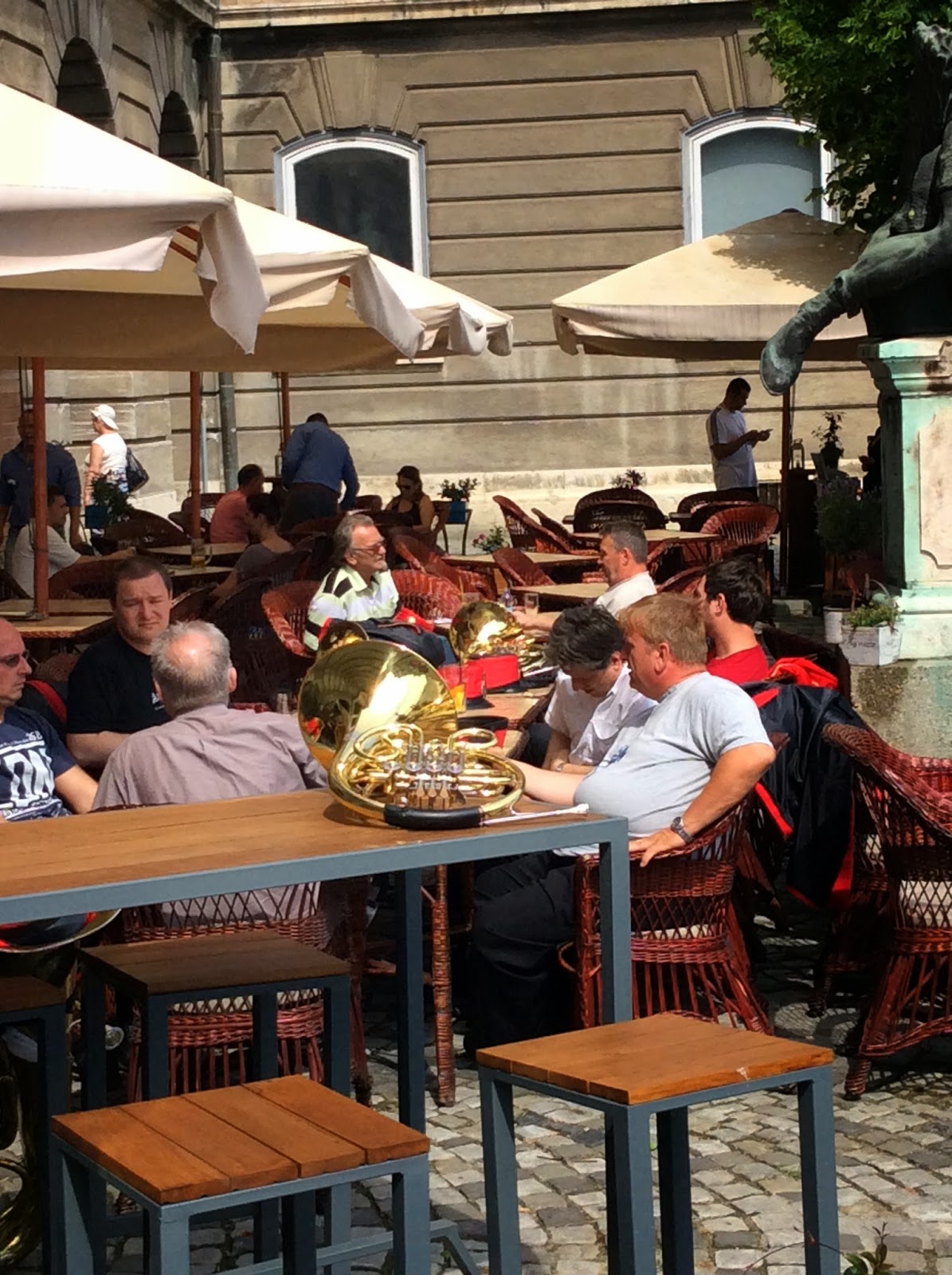
 We go to the Hungarian National Art Museum, and see how various artistic movements made their way to Hungary, from the 15th century revival of spatial perspective to French Impressionism and later 20th century Expressionism. While we are viewing some magnificent gilded folding alter pieces from the Gothic era, we hear a large crowd and loudspeakers outside. There is some sort of soccer rally taking place, as tonight is  the final of the Champions title for the World Cup preliminaries. Groups of men are dressed in national jerseys and carry signs for their countries. We thought they were teams, but since the game being played is between two Madrid teams, it doesn’t seem likely, perhaps they are just fans, yet they seemed to have plastic IDs around their necks. From a balcony of the art museum, which was the palace built by Queen Maria Theresia (queen of Austria and Hungary in the 18th century), we hear the Hungarian national anthem, followed by lots of chanting, and then they start playing “We Will Rock You”  and nearly everyone is singing along, quite a spectacle. I guess when there is a song called “Hungarian Rhapsody” somehow music by Queen works. And then we see a whole group of French Horn players, with part of their costumes off due to the heat, hanging out by the museum after performing.


Back to the ship for lunch and a farewell to Tihomir, and we head off to the Starlight Suiten Hotel. We check into what seems like a huge room, bedroom plus parlor, absolutely immaculate and so spacious after the shipboard stateroom. They were so helpful, and even sold us some metro tickets (we always ride public transit wherever we can).

Off to the huge Central Market, with mostly food of all kinds on the first level, and a second level with textiles, small cafes and every imaginable souvenir. We find a nice autumnal fabric runner for the table, and take a tram to Andrassy Street, one of the main streets in town.


We visit the House of Terror Museum, a sobering place which was the headquarters of the Nazis and the Hungarian Communist secret police and security people, where tens of thousands of people suspected of even the smallest infractions against the rigid political system were imprisoned, tortured and many executed. I like to think that I am fairly good at history, but the one hour we spent here (and I recommend it) made me realize how little I knew about Hungary and the mid-20th century here. They went directly from the terror of Hitler to the crushing totalitarianism of Stalinism. The Arrow Cross was the Hungarian version of the Nazis, and they were brutally efficient in executing Hitler's orders about Jews, with nearly half a million sent to death camps in just a few months. The German and Hungarian armies defended Budapest like a fortress, with the Germans blowing up most of the bridges and tens of thousands of buildings, and more than a million people fled Hungary. Then when the Soviets rolled in late in 1945, they simply took over the existing secret police structure and took more than 200,000 people into the gulags (brutal work camps), from all walks of life, from peasants to intellectuals and even Raoul Wallenberg, the Swedish diplomat who has saved thousands of Jews.    By the end of the way, 10% o the Hungarian population had died and the country was in ruins. Through a campaign of terror, the Soviets took over the government, even though they never had more than 20% of the vote, dissolving Parliament, abducting and killings political lleaders, until the dictatorship was firmly in control.  Ending private ownership, requiring large quotas of agricultural products be sent to the USSR while the Hungarians starved, ending the judicial system, urging people to inform on their neighbors and family members, repressing the religious organizations, it was a terrible time. A resistance arose, the AVO and then the AVH (secret police) brutally repressed anyone who spoke out, and tens and thousands spoke out while thousand more were executed. The brief and unsuccessful revolution in 1956 lasted only two weeks, and as the Soviets called the resistance fighters fascists (how similar to Ukraine now), they brought in the tanks and brutally put down the uprising, jailing tens of thousands and executing thousands as well.  The political repression continued, Hungary slowly rebuilt itself (20% of their post-war budget went to pay reparations), and they remained isolated for 30 more years. When the Soviet Union collapsed, Gorbachev actually apologized to the Hungarians for the occupation, repression and putting down the revolution. The last Soviet soldier left Hungary in 1991, and the last Hungarian prisoner of war returned from the gulag in 2000. The building where the House of Terror is located was the headquarters of the secret political police, both Hungarian and Russian, and in the center stands one of the tanks that blazed through the streets of Budapest in 1956.  If you go to Budapest, I highly recommend this (though it is not for children). http://www.terrorhaza.hu/en/index_2.html

We went to see Anne Godon, daughter of Catherine Godon and a friend since the girls first met in 3rd grade at Ecole Bilingue We meet her boyfriend and housemates, and go for a lovely Italian dinner on Andrassy.


She is now in Budapest doing a year abroad in her Master’s program in psychology. We saw her flat and met her boyfriend, Thijs, who is Dutch and very nice. It was great to see Anne again … it has been a few years. We visited for a while and caught up, and then took her out for dinner ot her favorite Italian place.  We had an interesting conversation, about what marriage really means and why people get married, and it was quite a stimulating and intellectual conversation. It is so wonderful too see young people that we've known in some cases since age 5 or 8 years, now grown into young adults who are bright, well-informed, and making their way in the world. We hope Anne will visit California sometime soon, and are glad that Madeleine will be seeing Anne in Paris in July.

Sunday, 25 May 2014

We wake up early in our hotel, have a quick continental breakfast, and we’re ready to go. It is raining now, so we really lucked out with our weather.

After 30 minutes on hold with AirCanada with no success, I go to the Lufthansa website and voila we are able to confirm our seats. However, this then requires a printer or  mobile phone to send the passes to … aaaargh! Luckily, the very nice desk clerk offers to let me us their computer and we print out boarding passes to Frankfurt and then to Calgary. After that we’ll deal with it, but at least we have seats across the pond. A quick, smooth drive to the airport in a cab (public transit trains are far apart early on Sunday morning), and we’re in the airport. Miraculously our boarding passes seem to be valid, to my relief. Security went fine … it amazes me how different systems are from place to place. Shoes or no shoes, computer by itself or not, etc. We’re at the gate, flight looks on time, so we’re off!

The river cruise was overall quite nice, and just perfect for spending time with relatives instead of dealing with transit and tickets, etc. I think the pace was nice for Carl and Sally, Chris enjoyed doing his photography, and Thomas enjoyed the music and culture. The service on the ship was superb, the food excellent, and it was really nice being close to the central city in Regensberg and Budapest. Interestingly, it was after we left the tour and went on our own to the Hungarian National Museum that it really felt like our normal vacation.

So glad we have Memorial Day to recover. Auf wiedersehn!

Budapest soaring architecture and sad history

Friday, 23 May 2014

As we arrive in Budapest around 7:30am, we got up to the sundeck to see the approach to Budapest, which is lovely, built on two sides of the river. We take a city bus your, driving around the large and beautiful green Hero’s Square, which is closed for a rehearsal for a military parade. The guide told us that during the winter the large artificial lake freezes and lots of people go ice skating, which sounds fun. Then through the old Jewish quarter, which has the second largest synagogue in the world (largest is in NYC).

Across the Elizabeth Bridge (there are many in Budapest, and the large Chain Bridge near our boat’s mooring was partially demolished during the war and rebuilt), to the Castle area.

 We exit the bus, have some great views, and walk up a medieval street to the Mathias Church (he was not a saint, but a revered King of Hungary who expelled some invaders, the Hungarians have been invaded a lot). The entire interior was re-done in Art Nouveau style after war damage so it is quite recent, though the ceramic tile roof is older.


After some nice views from the Fisherman’s Bastion, a lovely lookout spot, we walked down a small, dark lane and enjoy an ice cream ( it is about 87 degrees out today and very humid). Our guide and another guide are relaxing at the same cool spot.


We walked the back lanes to return to the bus, and then back to the ship. In the afternoon, we found our hotel (only 2 blocks away), saw the memorial to Hungarian Jews (more on this below), and walked around central Budapest.  In the heat everyone walking around seemed exhausted, I gather it is not often this hot here, so few places have air conditioning. We were pretty hot too, and glad for some cool air after our return. I am finally able to get the phone to work, and connect with Anne Godon, daughter of our friend Catherine Godon in Paris, who is doing a year of her Master’s studies in Budapest, and plan to see her Saturday afternoon.

On the morning tour, we learned that during the war, 95% of the Hungary’s pre-war Jewish population of about 500,000 was killed or deported, so today the Jewish community is small (about 2% of the total population) and slowly growing. When we get back to the boat, a short walk away on the riverbank  is a memorial to a group of about 200 Jews who were shot dead and pushed into the river by the Hungarian Nazis (called Arrow Cross), after D-Day when the Nazis were clearing losing but the extermination continued.  It is a long line of cast bronze shoes just as if people had fallen out of them. It is quite moving.


On our final night on the ship, all six of us collectively gave a special tip to our waiter, Tihomir, who is from Serbia originally, and now lives in Kiev with his wife and son. Their system here is to work 4 weeks, then they get 2 weeks off. He has a wonderful sense of humor (it is always amazing to me how someone can makes jokes in a second language), after one meal he remembered what everyone drank at which meals, and he always had a positive and uplifting effect on everyone around him. We had a long conversation with him before we left on Saturday, and he talked about philosophy of being always positive, how he enjoyed traveling with his family, and how he hoped too come to the US some day. We invited him to visit California sometime, as he also knows someone in LA. He gave us his email and asked us to send the photo of the extended family he took of us … he said he liked to have the photos of people he felt he made a nice connection with on the ship. I think he will soon be rising to be the overall director of the ship.